
189: Do you ever really win at baseball?
A look at the 2026 Men's College World Series National Championship and a look back at the 2006 title.

North Carolina meets Oklahoma in the first game of the 2026 Men’s College World Series National Championship in Omaha tomorrow.
Baseball is a tricky sport to determine the best team. As Oklahoma’s head coach, Skip Johnson, shared earlier this week:
Do you really ever win at baseball?
Years ago, a paper was published that studied randomness in sports and how often the best team wins across different pro sports. It’s a concept I routinely return to around this time of year, right as the NBA and NHL are wrapping up their seasons.
Michael Lopez, Greg Matthews, and Ben Baumer compared the NBA, MLB, NFL, and NHL. The paper found that in the NBA in a seven-game series, the better team won about 80 percent of the time. It’s much different though for other pro leagues.
In order to match the NBA’s better team advances rate of 80 percent of the time, it would require:
a best-of-11 series in the NFL
a best-of-51 series in the NHL
a best-of-75 series in MLB
Think about that.
A 75-game series because the margin between outs can be that thin.
College baseball’s NCAA Tournament format is different from pro baseball. A team needs to win at least three games to advance out of the Regional, two games to win a Super Regional, and at least five games to win the College World Series.
You can’t win a National Championship without performing in the month of June. Both North Carolina and Oklahoma are proof.
Carolina’s steady pitching and hot bat
We’ve covered that Carolina’s strength is pitching and defense over the past couple of weeks. UNC has turned 60 double plays in 66 total games this season and its 0.983 fielding percentage is one of the best in the country.
Carolina’s pitching staff, especially its starters, was not all that efficient entering the NCAA Tournament. For example, Jason DeCaro and Ryan Lynch combined for only 7.1 innings pitched in two starts in the ACC Tournament.
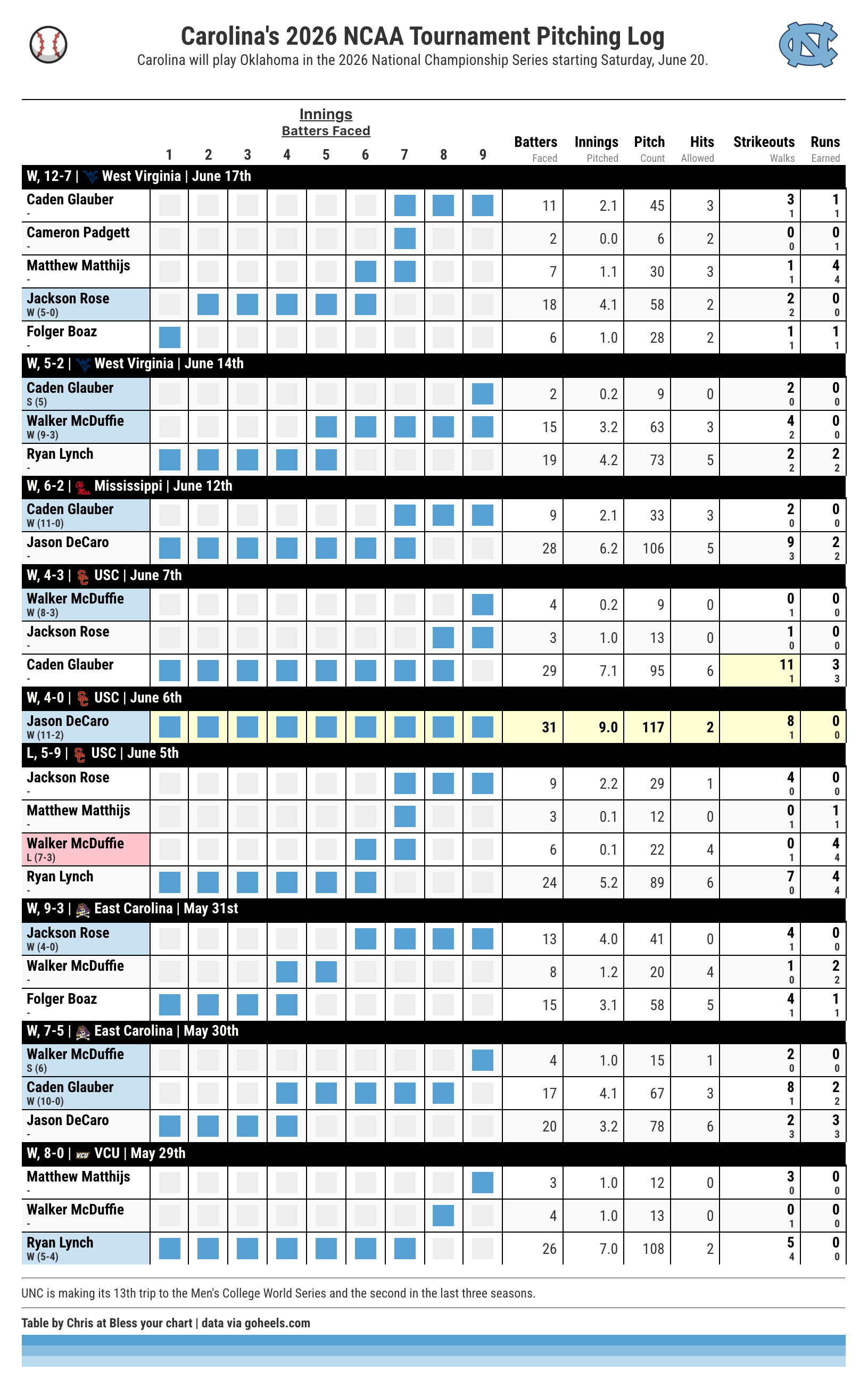
The staff has been much better in the NCAA Tournament. The emergence of freshman left-hander Jackson Rose has strengthened the staff. Rose has thrown 12 innings in the NCAA Tournament and allowed zero runs on just three hits.
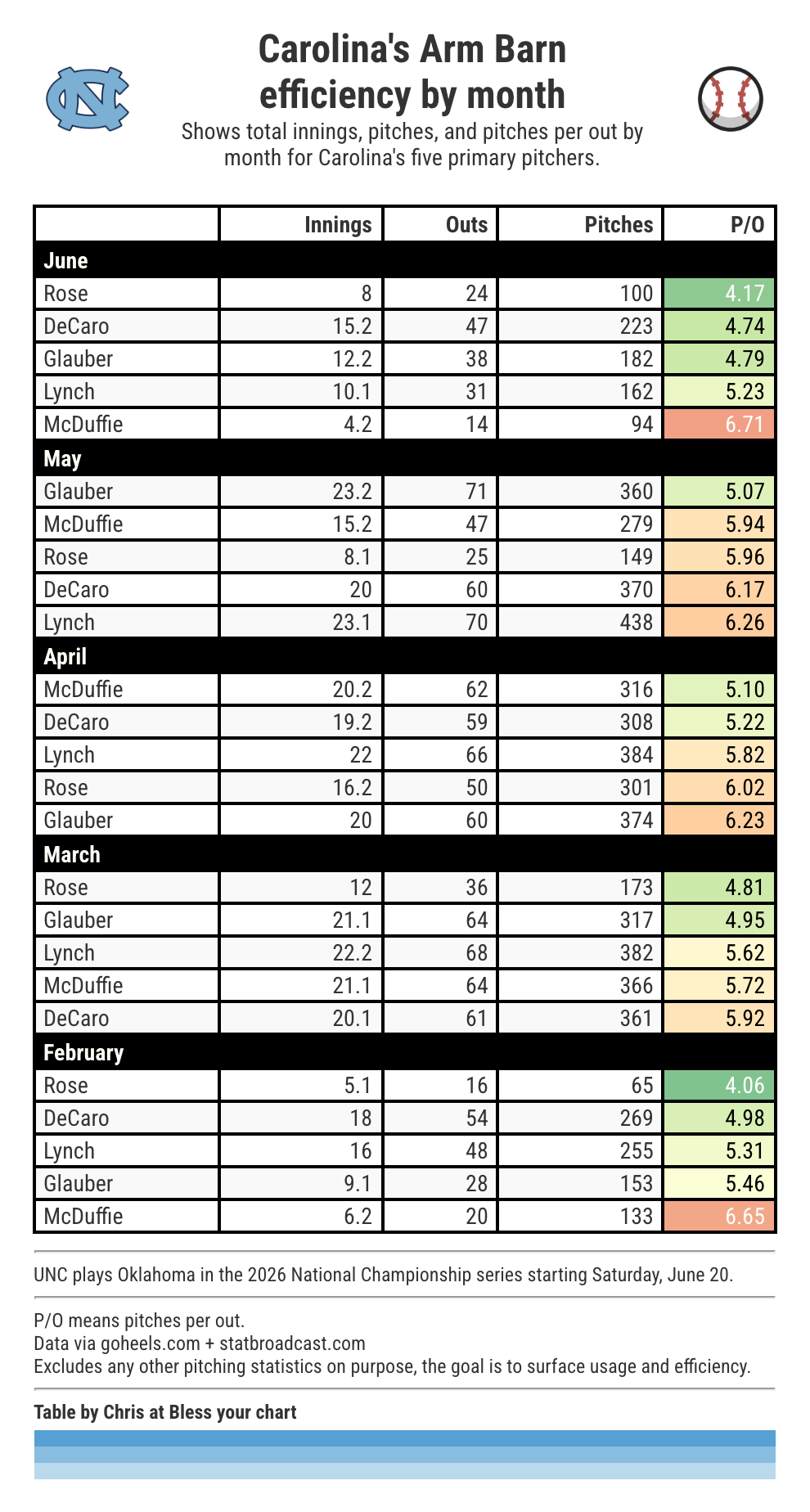
Take a look at the pitches per out for Carolina’s five primary arms by month of the season. In the months of April and May, none of these five pitchers averaged fewer than five pitches per out. Three of these five pitchers have done that in the month of June.
The efficiency on the mound has allowed Carolina to maintain an advantage and avoid taxing its staff. Here is a look at the entire pitching log for Carolina’s nine NCAA Tournament games so far.
The staff’s improved efficiency paired with timely hitting means Carolina has lost just once in the NCAA Tournament. UNC has seven players with 48 or more RBI. Owen Hull leads the team with 85 RBI. Hull leads Carolina’s offense in multiple categories, and he has been red hot in the month of June.
Here is a look at Hull’s offense by month of the season.
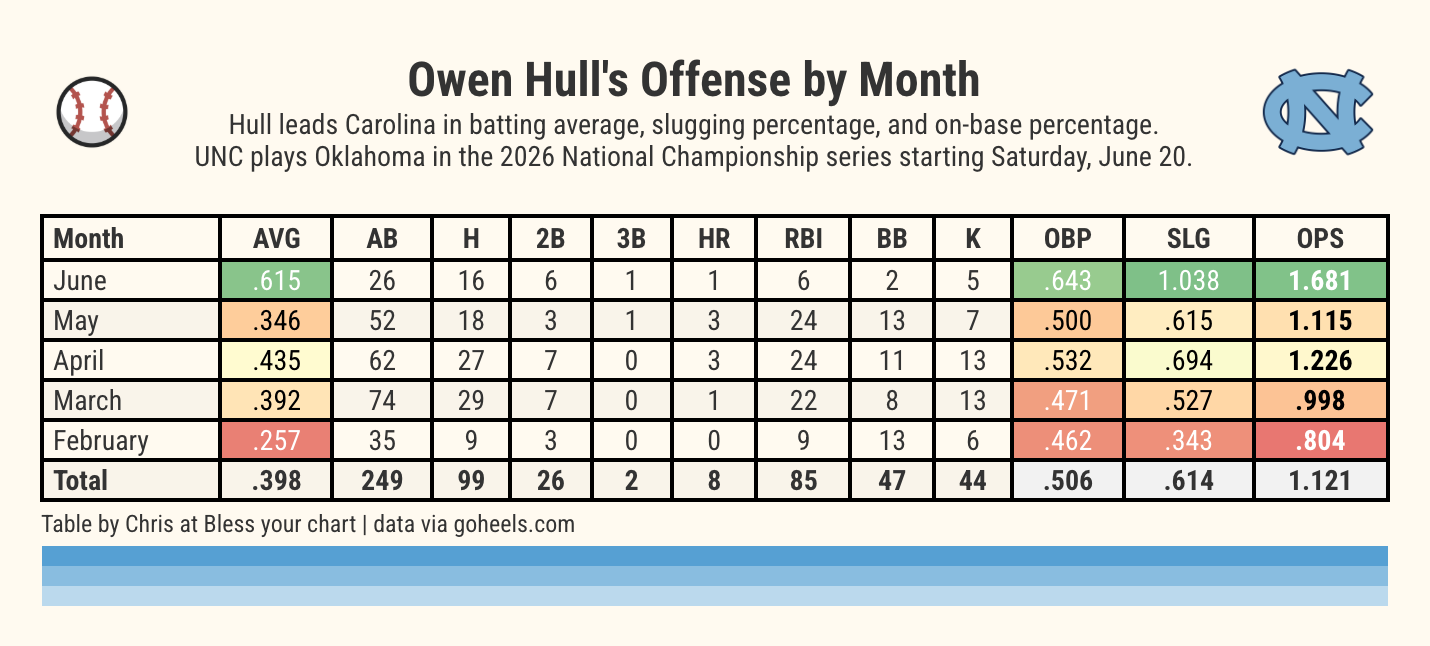
Hull has seven more hits in the month of June in nine fewer at-bats than he had in the month of February. The junior has gotten on base around 64 percent of the time over the six games in June. He is slugging over 1.000 with eight extra-base hits.
If Carolina wins the National Title Monday, it’s going to need Hull and its pitching staff to continue the June performances.
Sooners’ offense is booming
Oklahoma has hit 26 of its 91 home runs this season in the NCAA Tournament. The Sooners have homered in all 10 NCAA Tournament games.
Bradley Smart, from D1Baseball.com, put together this chart to show the power distribution of the Oklahoma offense.


45 home runs in the last 20 games after 46 home runs in the first 43 games. The power surge has the Sooners scoring 9.4 runs per game in this NCAA Tournament.
Oklahoma’s pitching is being overshadowed by the offense, but the Sooners have allowed just over 4 runs per game in the NCAA Tournament. The squad has allowed only seven runs in three College World Series games too.
Luck and unforced errors
A best-of-75 series might be needed in MLB to determine the best team. Oklahoma and North Carolina will play a three-game series starting tomorrow.
Unforced errors are a key difference between amateur and professional sports. As you see in tennis, amateurs lose over 70 percent of points on unforced errors compared to professionals. The same can be said in the game of baseball.
Carolina last played in the National Championship Series in 2006 and 2007. The Heels lost both series to Oregon State. The Beavers needed only two games in 2007, but they needed all three games to defeat Carolina in 2006.
Carolina won game one in 2006 and the Heels had a 5-0 lead entering the bottom of the 4th inning in game two. After allowing seven runs in the bottom of the inning that included a wild pitch ricocheting into the Beavers' dugout to allow a run, Carolina lost game two 11-7.
Game three is a good microcosm of baseball. Oregon State beat UNC 3-2 to win the 2006 title. It's the way Carolina lost that stings.
The unforced errors.
Second baseman Bryan Steed’s errant throw led to an unearned run in the bottom of the eighth, and it proved to be the game-winning run. It’s easy to remember Steed’s miscue because it was the end of the game.
It's much harder to remember that the game-winning run reached base on a two-out walk. Carolina also made four total errors that game and two of Oregon State’s three runs were unearned. Pitcher Daniel Bard’s throwing error after fielding a bunt led to the game’s first run in the bottom of the fourth inning.
In the top of the sixth inning, and the game knotted at two, Carolina had runners at first and third with only one out. Tim Federowicz hit a groundball to third, and Oregon State threw out Josh Horton at home. Jay Cox was then caught in a pickle between second and third, and thrown out.
Unforced errors in the form of poor baserunning ran Carolina into a double play.
Later in the top of the eighth, Carolina had the bases loaded with only one out. Seth Williams went down on strikes to make it two outs. Horton then broke to steal home, and looked to have it stolen, but Benji Johnson swung at a pitch outside for strike three to end the inning.
The team with fewer unforced errors often comes out on top in amateur sports, especially baseball.
Because after all, do you really ever win at baseball?
That’s it for this week, and thanks for reading this far.
D1Baseball.com’s Bradley Smart is a recommendation for this week. He puts out a lot of great data visualizations. Here is another one that shows Oklahoma’s home runs over the season.