
188: Omaha
A few charts ahead of the Men's College World Series.

The Men’s College World Series starts Friday, June 12 in Omaha, Nebraska. Two brackets of four teams compete with the winners meeting in a three-game series for the National Championship.
Let’s take a look at how the eight teams made it to Omaha using run differential by inning, we’ll start with the first bracket of teams slated to play on Friday.
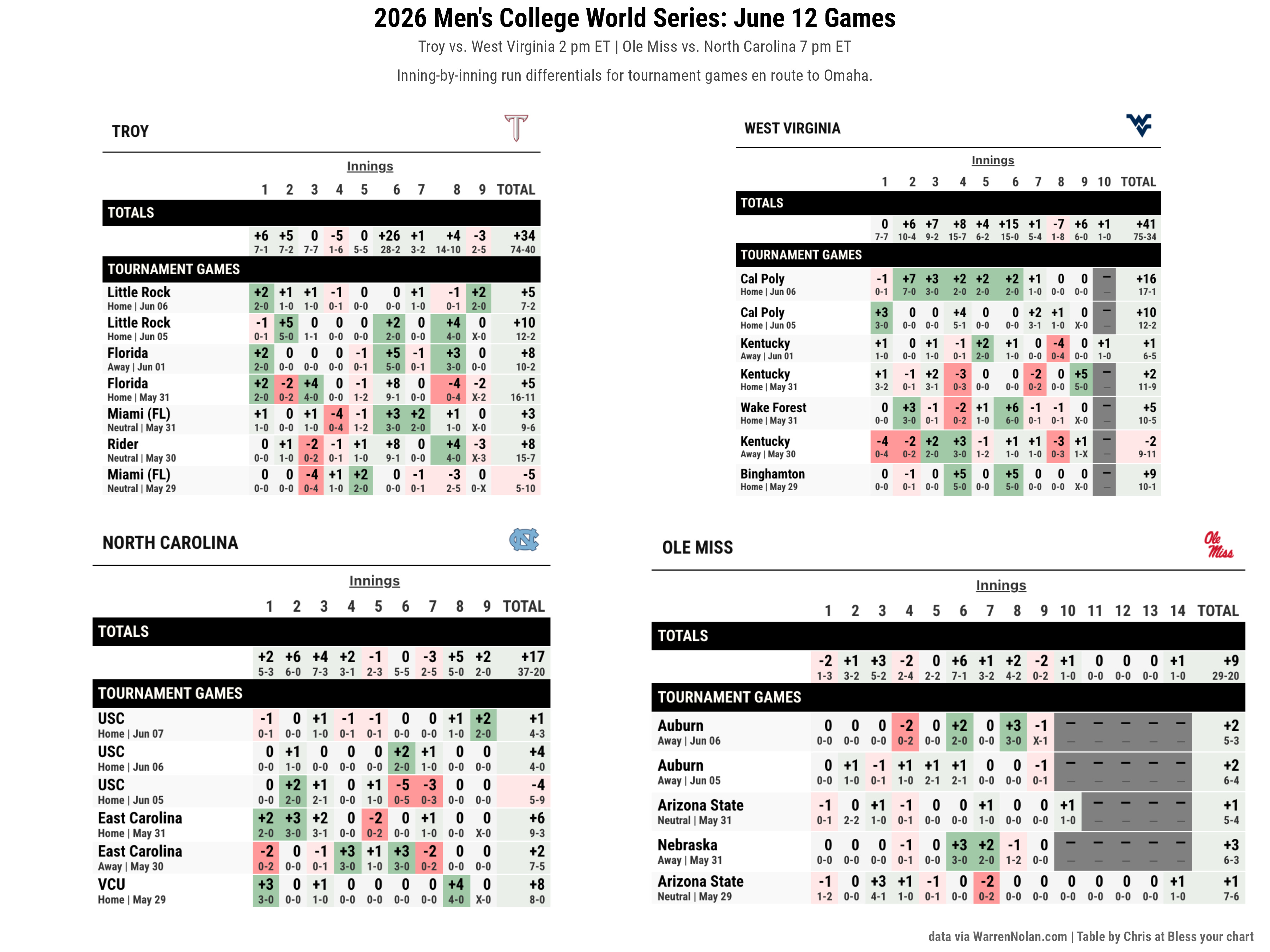
Both Troy and West Virginia dropped a game in the opening round or Regional, and both those teams dominated in the Super Regionals. Troy defeated Little Rock by a combined 15 runs over two games and West Virginia beat Cal Poly by a combined 26 runs in two games.
The run differentials look a bit different for North Carolina and Ole Miss. Both teams have allowed just 20 runs, Carolina over six games and Ole Miss over five games.
Ole Miss has won all five of its games by a combined nine runs, including a pair of extra-inning wins against Arizona State in the Lincoln Regional. North Carolina cruised in three wins hosting a Regional and defeated USC in the Super Regional round by a combined margin of one run.
The other side of the bracket tells a different story.
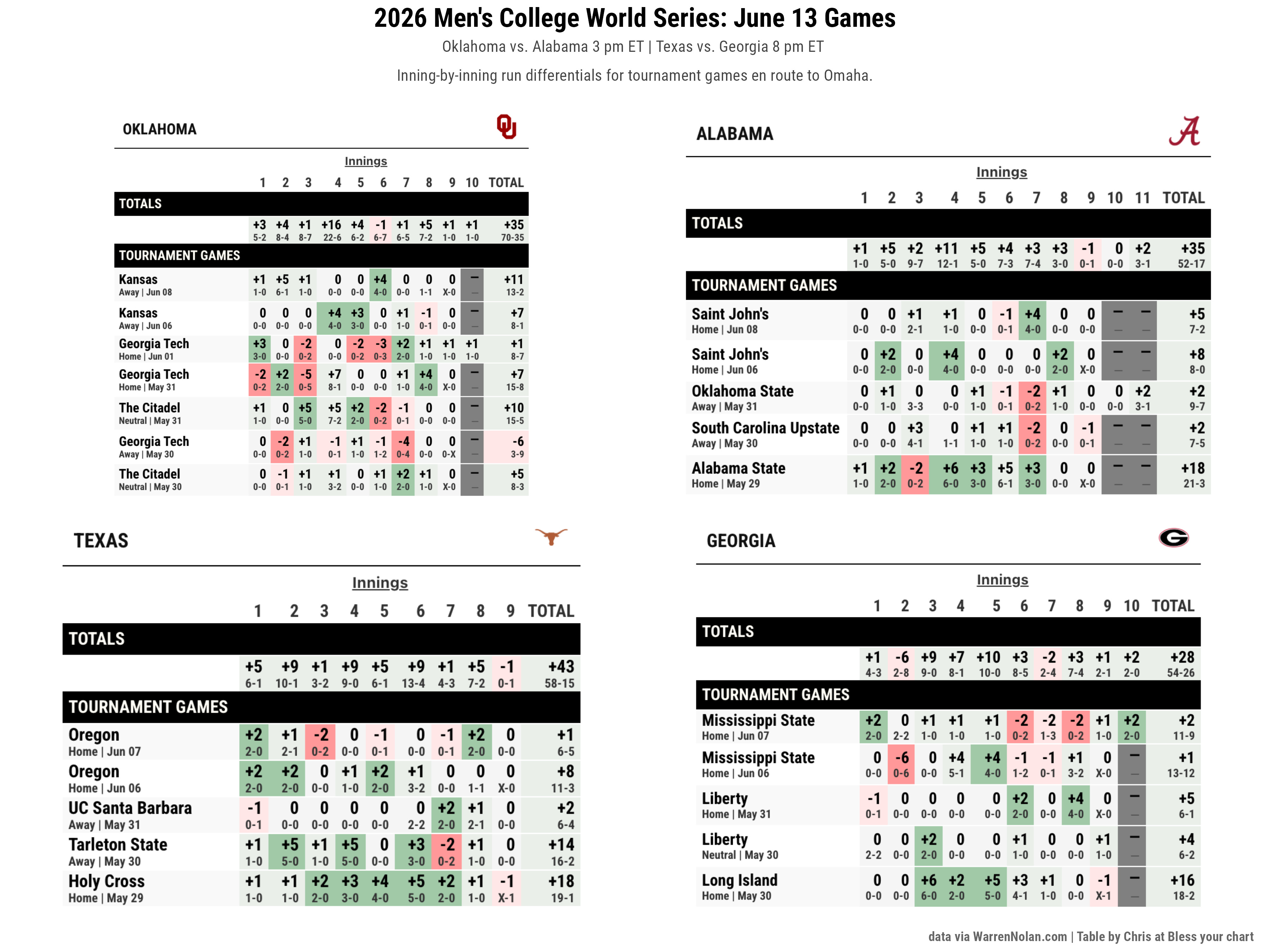
Oklahoma meets Alabama on Saturday, and the Tide beat the Sooners two-out-of-three games earlier this season in Norman, Oklahoma. The Sooners had a stress-free Super Regional beating Kansas by a combined 18 runs over two games, but its upset over host Georgia Tech in the Regional round was anything but easy.
Alabama has allowed only 17 runs over five games, which is the second fewest amongst the eight teams in Omaha. The Tide did need extra innings to beat Oklahoma State in the Regional round, but they handled St. John’s in the Supers without much issue.
Texas and Georgia have yet to lose in the NCAA Tournament. The Longhorns’ +43 run differential over five games is the best amongst the field in Omaha. Georgia allowed 21 runs in its two wins over Mississippi State in the Super Regional round, which is more runs than Texas (15 runs in five games), Alabama (17 runs in five games), Ole Miss (20 runs in five games), and North Carolina (20 runs in six games) have allowed the entire tournament.
Carolina’s pitching log
Twenty-three different teams have advanced to the Men’s College World Series in the past three seasons. North Carolina is the only team that has been there twice, 2024 and this season (2026).
Carolina is making its 13th trip to the College World Series and ninth since 2006. The Heels made it all the way to championship series in both 2006 and 2007 in large part because of its pitching staff.
Pitching and defense have defined Carolina baseball over the past 20 seasons, and this season is no different.
UNC has used seven pitchers over its six NCAA Tournament games. Carolina got 22 of 27 innings out of its starting pitching in the Super Regional series win over USC, including a complete-game two-hit shutout from Jason DeCaro.
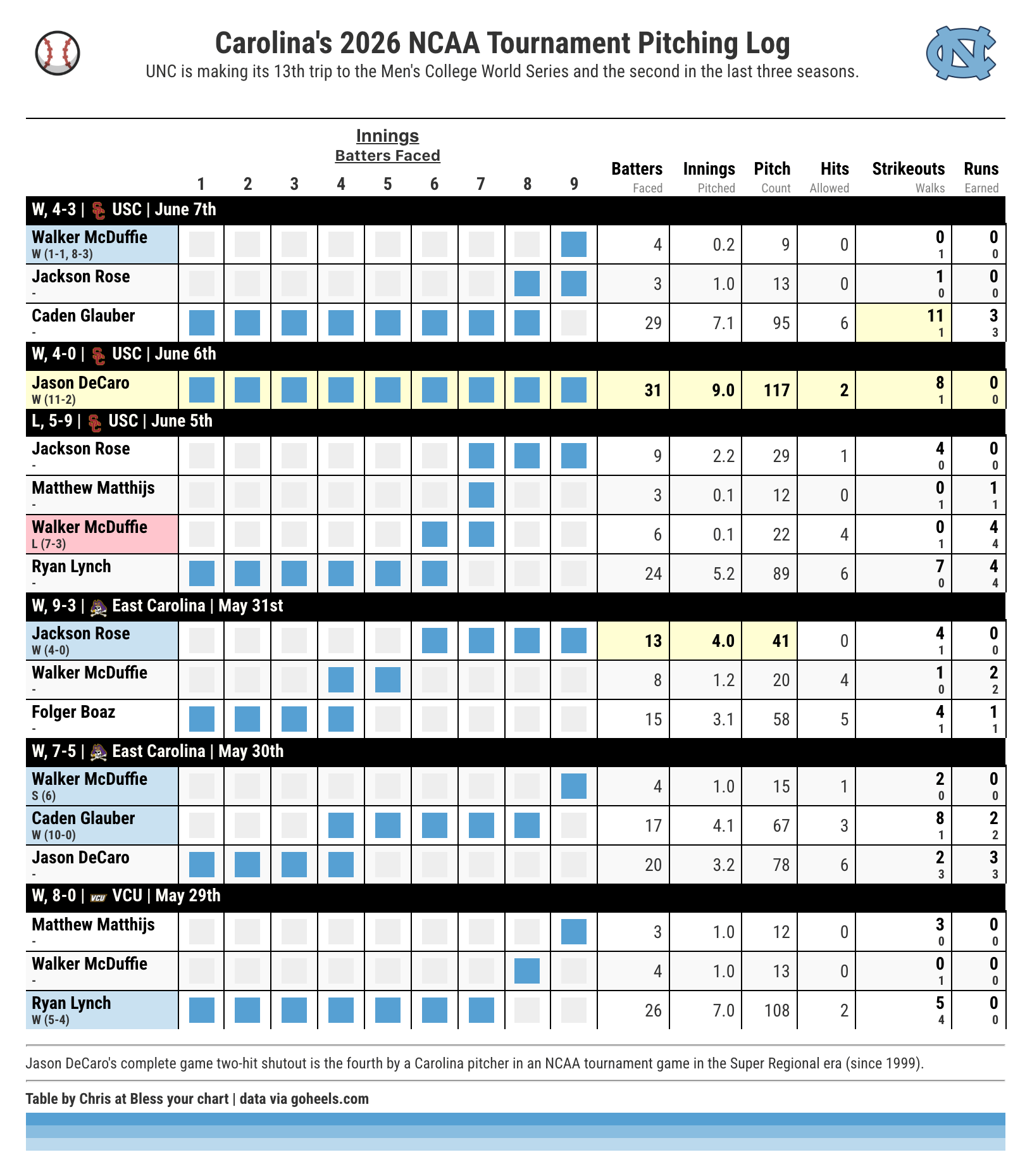
The pitching has been UNC’s strength all season and if Carolina can score seven or eight runs, the Heels will be tough to beat.
The format in Omaha gives advantages to teams with pitching depth. The opening round is similar to a Regional format, but with more rest after the first game, and the National Championship is a traditional three-game series.
Carolina’s 13 College World Series appearances are the second most by any team without a National Title. Only Florida State has more (24 total).
If that streak ends over the next two weeks, it’s probably because of Carolina’s pitching and defense.
A quick detour to talk about the SEC
Here is a hypothetical Q&A to talk about the SEC:
So, the SEC dominates college baseball, right?
The SEC has five members in the 2026 Men’s College World Series, the most ever by a single conference. This will be the ninth straight College World Series that features an SEC team in the National Title series.
If a team from the SEC wins it all, it will mark the seventh straight year a team from the conference has won the National Championship.
The SEC now has 16 members and 14 of those 16 members have made it to Omaha this decade too.
Got it, it must be weird that these teams play each other in the regular season and in Omaha again?
Not quite.
Georgia is on one side of the bracket and despite sharing SEC membership with Texas, Alabama, and Oklahoma, the Bulldogs didn’t play any of those three teams during the regular season or SEC conference Tournament this season.
In fact, Troy has played more games against SEC teams (two against Georgia, two against Alabama) than Georgia has played against the SEC teams in Omaha (three against Ole Miss).
Ah, so maybe conference dominance doesn’t mean what we think it means?
Make no mistake, the SEC and its members invest in college baseball. It’s been this way for a while. The league had four teams in the College World Series in 1997 and 2004.
There were 12 SEC teams playing baseball in 1997 and there are 16 teams today. The SEC didn’t add small schools either. Both Texas and Oklahoma came from the Big 12 and joined the league in 2024.
It’s possible I have a bad attitude about the fawning over SEC dominance in the sport, but how in the world is this surprising?
You added a team (Texas) that has won six National Titles, and we’re surprised that team is making it back to Omaha?
All the member schools don’t even play each other because of the bloated conference. We can’t have them play in the opening round of the NCAA Tournament because silly rules the committee doesn’t like change.
What is more surprising and a better story is that teams like Murray State and Troy have made it to Omaha despite playing in smaller leagues.
That’s it for this week. A few recommendations and fun data visualizations that caught my eye as of late:
This decision quality chart from Isaiah Ochoa is a fascinating look at Owen Hull’s performance during last week’s Super Regional. Hull has as many hits (9) over three games in June as he did in 12 games in February.
Shotgun Spratling of D1 Baseball shared West Virginia’s Chansen Cole’spitch chart for this past weekend. 121 pitches and none we’re in the upper third of the strike zone, allowing two runs on eight hits against Cal Poly.
The World Cup starts tomorrow, and Luke Benz put together these simulations, which is handy given the expanded field.
🤟 Enjoy Omaha or the summer or the World Cup 🤟