
178: Sunday selections
A look at the 2026 NCAA Tournament field.

We’ve made it past Selection Sunday, so let’s take a look at the 68-team field.
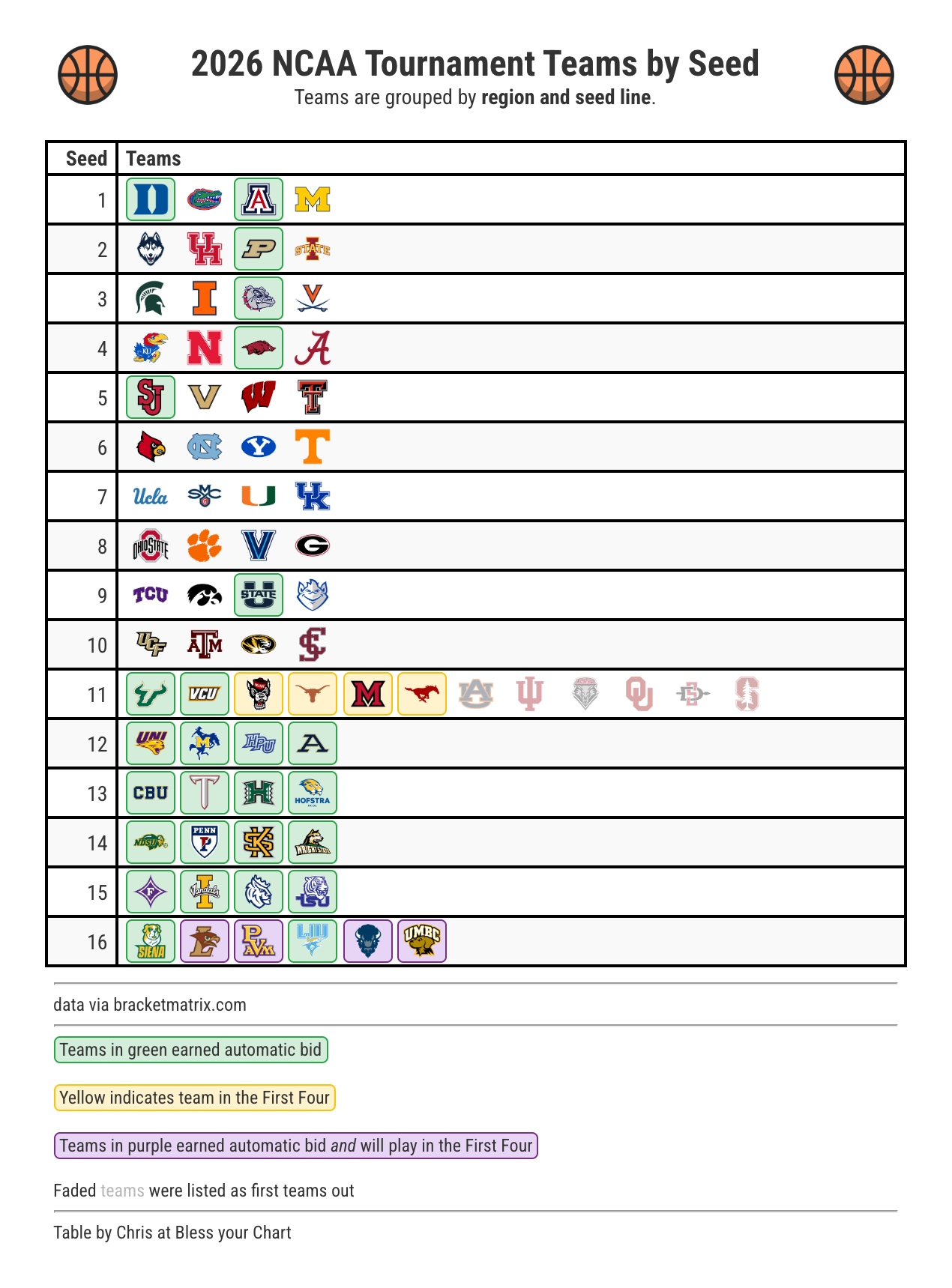
By the numbers:
27 teams in green earned an automatic bid and 25 of those teams were seeded 9 through 16
Four teams in yellow earned an at-large bid in the First Four or the play-in games (NC State, Texas, SMU, Miami Ohio)
Four teams in purple earned both an automatic bid and will also play in the First Four (Lehigh, Prairie View A&M, Howard, and UMBC)
Six teams were listed as the first teams out (Auburn, Indiana, Oklahoma, San Diego State, Stanford, New Mexico)
So what about the teams on the bubble?
There are tons of different ways to compare bubble teams. Pick your poison or select the data you want to use to make your case.
In this house newsletter, we believe in using Wins-Above-Bubble (WAB) and the data we’ve been tracking all season over at wabwatch.com.
You can use any power rating to calculate WAB. We’re using Bart Torvik’s ratings because these ratings are public and tried-and-true over time. The NCAA uses their own NET ratings to compute WAB. Others can use Massey ratings or kenpom.
WAB tells you a lot about how a team performed against its schedule. This season gave us an extreme comparison, which is useful to understand WAB.
Miami Ohio earned an at-large bid and the Redhawks will play SMU on Tuesday in the First Four. Auburn was left out of the tournament.
Miami Ohio won 31 games, yet three of those wins were against Non-DI teams.
Auburn finished one game above .500, however, they do play in the almighty SEC and the Tigers were the only team this season to beat 1-seed Florida at home.
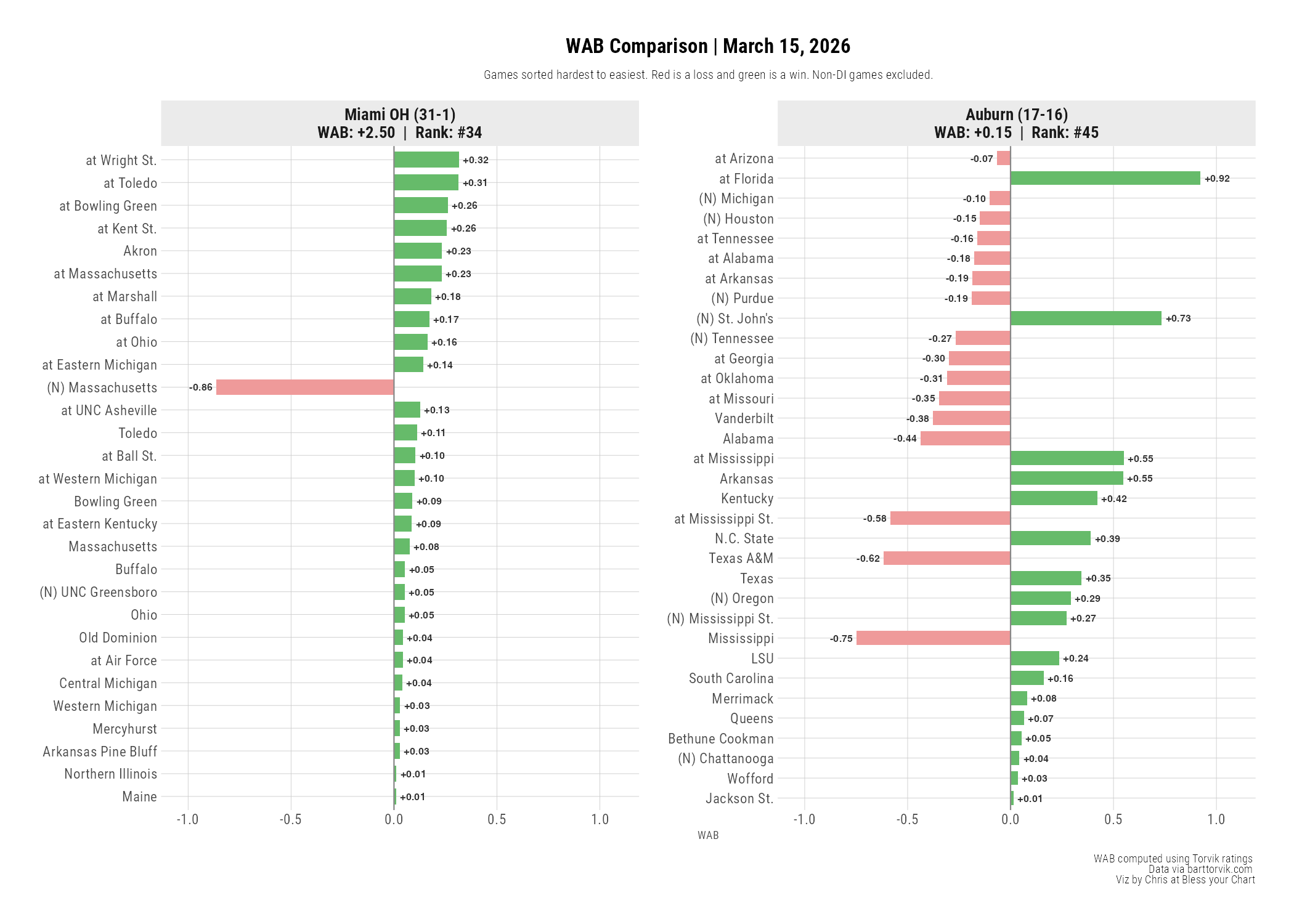
Auburn’s win at Florida is worth about the same in WAB as Miami Ohio’s wins at Wright State, at Toledo, and at Bowling Green.
Miami Ohio’s loss on a neutral floor against Massachusetts is more damaging than losing at Ole Miss, but the problem is Auburn also dropped games to Texas A&M at home and on the road at Mississippi State. Oh, and Auburn also lost 13 other games even though they were against quality opponents.
Miami Ohio shot under par on a par 3 course and Auburn shot above par at Torrey Pines. If you want, you can still compare any two teams with more data at wabwatch.com/comps.
For example, here is Auburn and SMU, which might surprise you:
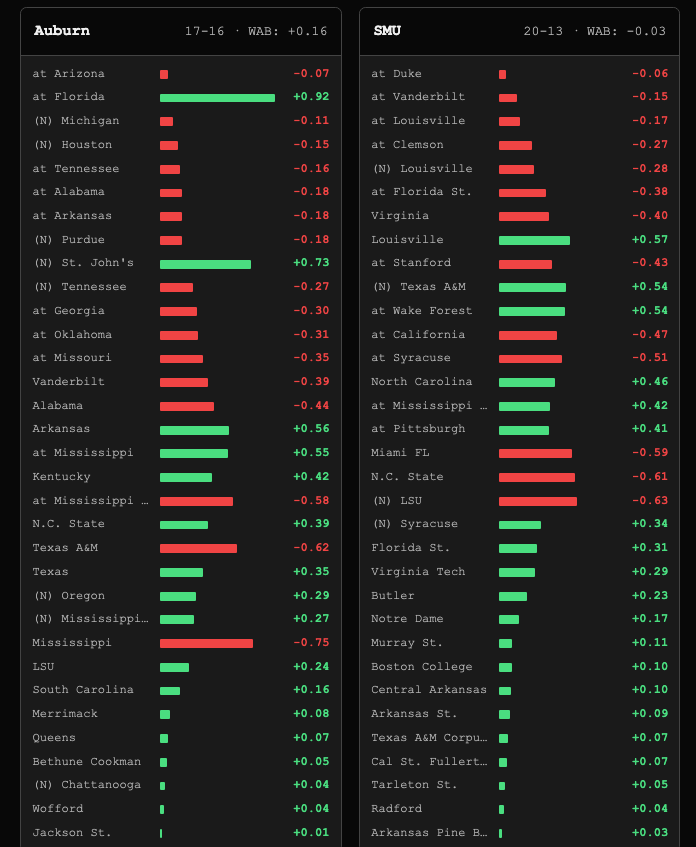
The committee’s job is not easy. In my opinion, the past two seasons have been a giant step forward in using WAB as a way to cut through noise and admit teams to the Big Dance. At the same time, last season’s inclusion of North Carolina was labeled a crime and miscarriage of justice. It remains to be seen if the others feels the same way about Auburn this season.
WAB feels like a better way to determine which teams deserve an at-large bid. It’s not perfect, however, it's sharpened part of the science of bracketology.
When it comes to seeding teams, it’s a little more art than science. There are tons of factors for seeding teams, including geography, injuries, predictive metrics, and even the goal of creating a compelling TV show.
March is supposed to be mad. The numbers we've tracked all season matter right up until they don’t. Now that we know the field, every team has a WAB of zero and no one cares about building a résumé in the tournament.
We just care about wins, and after all, isn’t that the whole point?
No matter a team’s past, once the tournament begins this week, every team has a spotless future.
Thanks for reading this far.
Huge thanks to bracketmatrix.com, which I frequented most of this week. It’s a great, free resource that can help you gauge where your favorite team might land in the tournament.
Hope to share some more data later this week, but for now, here is a CSV file of all the Tournament tip times for this week: wabwatch.com/data/tournament_schedule_2026.csv
🤟 Enjoy the week 🤟