
175: The same, only different
Wins-above-bubble equivalents.

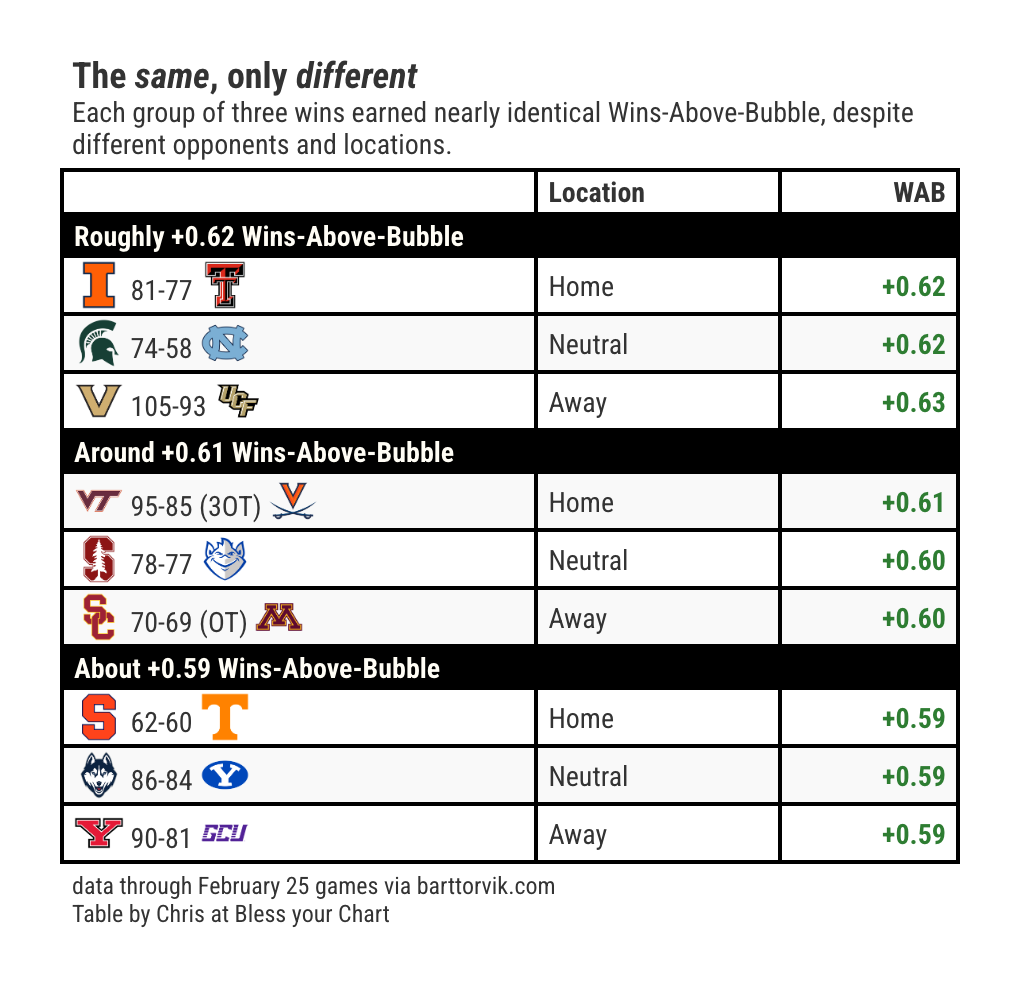
A win over Texas Tech at home is about the same as beating North Carolina on a neutral floor or beating UCF on the road.
And a win at Minnesota is similar to beating Virginia at home or Saint Louis on a neutral floor.
A win against BYU on a neutral floor is roughly the same as winning at Grand Canyon or beating Tennessee at home.
All of these results actually happened this college basketball season. These comparisons are made using Wins-Above-Bubble or WAB.
One of the reasons I like Wins-Above-Bubble (WAB) is I find it to be easier to understand. Sure, the math can be scary. The pronunciation of the WAB is confusing too.
Instead of pontificating what makes a win a quality win or even a quality loss, WAB summarizes it into one number. Almost nothing in the world is 0 or 100 or black and white, and WAB is no different.
You don’t need to check an opponent’s kenpom1 or Torvik rating to make sure it’s a quality win. You don’t need to rely on a fluctuating NET ranking without an explicit rating that bins teams into arbitrary quadrants.
And you don’t need to wonder if a team won the game by enough points or if the pace was right to project a better win2.
You can focus on the result. A win is positive and a loss is negative. How positive or negative depends on where the game was played and the strength of the opponent.
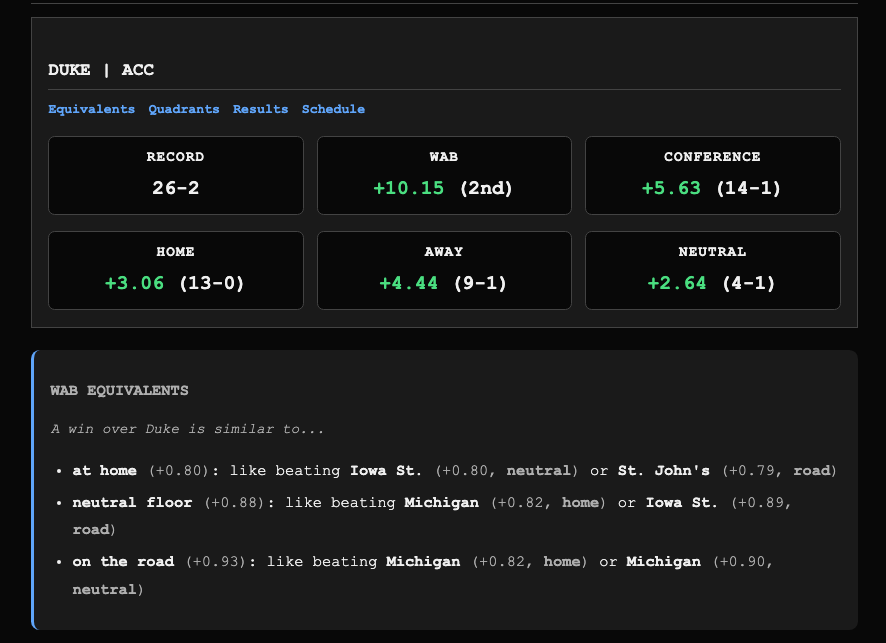
You can find other WAB equivalents over at wabwatch.com on any team page. For example, beating Duke is similar to . . .
It’s been fun to see WAB go mainstream over the past year. I do worry that it’s a new piece of information for a lot of fans, and you can get stuck in the weeds because there is so much information and data available today.
We rarely adjust what we think to fit new information. Instead we often do the opposite, by changing how we interpret information to fit what we want to believe.
I took no pleasure in beating the WAB drum last season as my favorite team reaped the rewards of the metric, and it was labeled a crime. I mean, wabwatch.com is one of the nerdier things I’ve ever put together, and if I had to build it over again, I would likely do many things differently3.
It’s much more fun to enjoy the sport for the actual happenings on the court. And yet here I am, running a WAB website, so take that with a grain of salt.
Bracketology overshadows a lot of those things this time of year, and we should not forget that the best part of March is not debating who gets in the tournament.
It’s the actual basketball.
That’s it for this week, and thanks for reading this far.
A recommendation this week is Patrick Stevens’ NCAA Tournament projections, Seeded Territory, published over at oviesandgiglio.com. Patrick has covered college sports and college hoops for as long as I can remember, and Ovies and Giglio picking up Patrick’s work after the debacle at the Washington Post was a great idea.
🤟 Enjoy the hoops this weekend 🤟
Again, I swear I once read that Pomeroy prefers that kenpom is all lowercase and not camelcase, but convinced I’m the only one that does that. No clue, if he was being pedantic or not.
Margin of victory is grossly misunderstood. All 20-point wins are not the same, and pace matters!
The reliance of quadrants is not great, including Quad 1A was a mistake in hindsight. Also, computing it via Torvik’s data was easier than guessing the NET raw ratings, but it would be fun to compute WAB across multiple power rating systems.
People are confused why the NET WAB and WAB listed on the site are not the same, even though as the season goes on these are getting more and more similar.