
171: Symmetrically Wrong
A look at the weather and college hoops.

Over the past 10 days, I’ve become somewhat of an amateur meteorologist. An ice storm and looming storm with potential for lots of snow will do that to you, especially when you have two young children.
I’ve thrown out the phrases, “dry slot” and “warm nose” in conversation like I know what they actually mean. I don’t really know what they mean.
Anywho, there are tons of different weather models. These models have fun acronyms like the NAM, HRRR, EURO, GFS, and ICON. There are global models and regional models.
The service, weather.us, answers the question of why there are so many models and why are they different:
Many different national weather centers have supercomputers that run weather models. Each of these is slightly different, using different equations to solve for various physical processes that shape our weather patterns. Many of them also have slightly different resolutions, and use slightly different combinations of initial data sources.
These slight differences multiply out through time because the atmosphere is a chaotic system. This also means any errors that the models make in the near term become exponentially larger with time. This is why the forecast for a week from now is far less accurate than the forecast for tomorrow.
The atmosphere is a chaotic system sort of like college basketball. 365 Division-I teams with wildly different schedules, skill levels, and access to professional players.
There are also lots of different “models” or power rating systems in college basketball. A few of the most popular models are built by Ken Pomeroy, Bart Torvik, and the NCAA’s own NET.
All three of these systems have ratings that aim to be predictive. These rating systems are slightly different, and use slightly different methods and combinations of data to reach slightly different resolutions.
It’s fun to compare the ratings too and how they might change over time.
For example, let’s take a look at Texas1.
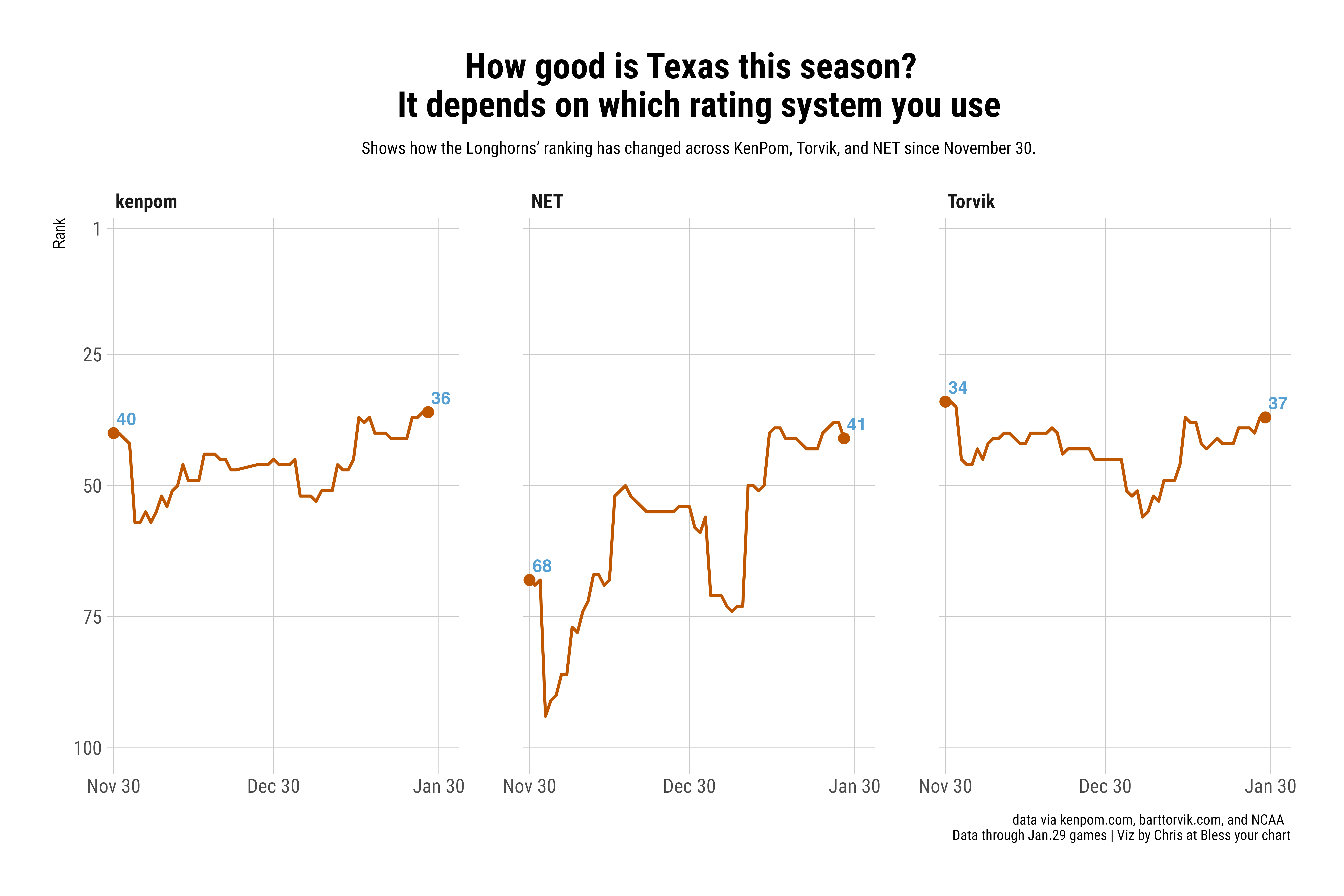
The NET rankings debut on December 1st, including data through games on November 30th. The Longhorns were ranked 68th in the NET based on this data, while Texas sat at 40th in KenPom and 34th in Torvik.
Unlike the NET, both Pomeroy and Torvik use priors or preseason ratings. Pomeroy had the Longhorns ranked 39th in the preseason, and Torvik slotted Texas at 37th ahead of the first game.
The NET doesn’t include any preseason priors, so it treats that first month or so of the season as its starting point for all teams. Texas was 6-2 through November 30 games with a 15 point loss to Duke and a one-point loss to Arizona State.
The Longhorns started at 68th in the NET, and then lost to Virginia by 19 points at home on December 3. This dropped Texas in all rating systems, but it plummeted the Longhorns to 94th in the NET through December 3rd games.
Now, the Longhorns have meandered all the way back to 41st overall in the NET today. This is close to where the Longhorns rank in kenpom (35th) and Torvik (37th), but the way Texas arrived at the ranking over the past three months is wildly different.
Asking “how good is Texas” is similar to asking how much it’s going to snow this weekend.
It depends on the model you used, but remember college basketball like the weather is a chaotic system.
You could answer the question 'How good is Texas?' in a number of different ways. The Longhorns are 12-9 overall and 3-5 in the SEC today.
Wins-Above-Bubble, using Torvik ratings, has Texas ranked 66th overall at around -0.46 WAB. Texas is on the bubble and bracketmatrix.com agrees as Texas is in only 44 of 99 brackets as of today.
If WAB were part of the weather forecast, it would be a record of what happened when you look outside after the snow has fallen.
It’s not predictive, and yet, it’s still wildly useful to compare teams. You can track WAB game-by-game over at wabwatch.com and this week I’ve added a Comps page to compare two teams.
For example, here is Texas compared to Virginia Tech:

It’s not lost on me that Ken Pomeroy was (is) a meteorologist? before he was taken out of context across college hoops. So when Gary Parrish points out that UConn started 5th at kenpom and the Huskies now rank 13th despite being 20-1, perhaps, you should consider the chaotic system that is college basketball. Also, remember the reality of rankings too?
Like the weather, Pomeroy is trying to predict how UConn will perform looking ahead, not what they’ve accomplished thus far. UConn is tied for second overall in WAB, for what it’s worth.
And this brings us to this week’s recommendation from Mike Beuoy. A short tweet that explains it all:
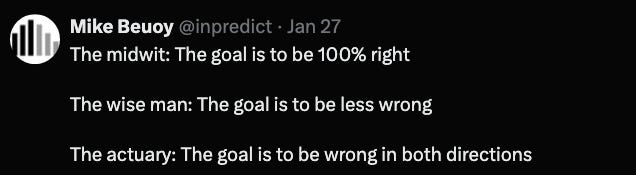
Most people want the rating systems to be 100% right, while wiser folks know the goal is to be less wrong, and the most skilled know the goal is to be symmetrically wrong.
Anyhow, that’s it for this week. Thanks for reading this far.
🤟 Stay warm 🤟
Texas head coach Sean Miller is a walking soundbite as of late. His team “will foul the shit out of you” (his words, not mine). He thinks his team’s second half defense against Auburn would not have been much worse with 4 players on the floor instead of 5 players.
oh wow, this is so interesting. never knew about the diff rating systems