
154: Punt blocks and wins
How often does a team that blocks a punt, win the game?

Last Saturday night, I settled in to watch the Notre Dame and Texas A&M game. Within the first two minutes of the game, the Irish blocked a punt and returned it for a touchdown.
Surely, the Irish went on to win this game, right?
A blocked punt, for a touchdown, to start the game, at home.
It turns out, Notre Dame found a way to lose the game, in part, because of its own special teams miscue1.
I wasn’t the only one who equated the blocked punt to a likely win.
Urban Meyer even tweeted out:
Block a punt….win 90% of time.
Of course, I was surprised the Irish lost the game.
It got me thinking back to this tweet, and the assumption that a team that blocks a punt, wins the game 90 percent of the time.
That feels like a lot.
So, I tried to verify that stat by parsing through the play-by-play for games between two FBS teams since 2016 using collegefootballdata.com.
It turns out what I found is nowhere close to 90 percent.
Across a sample size of 554 games between two FBS teams, a team that blocks a punt, wins the game around 63 percent of the time (350 wins, 204 losses).
A full season-by-season breakdown can be found below.
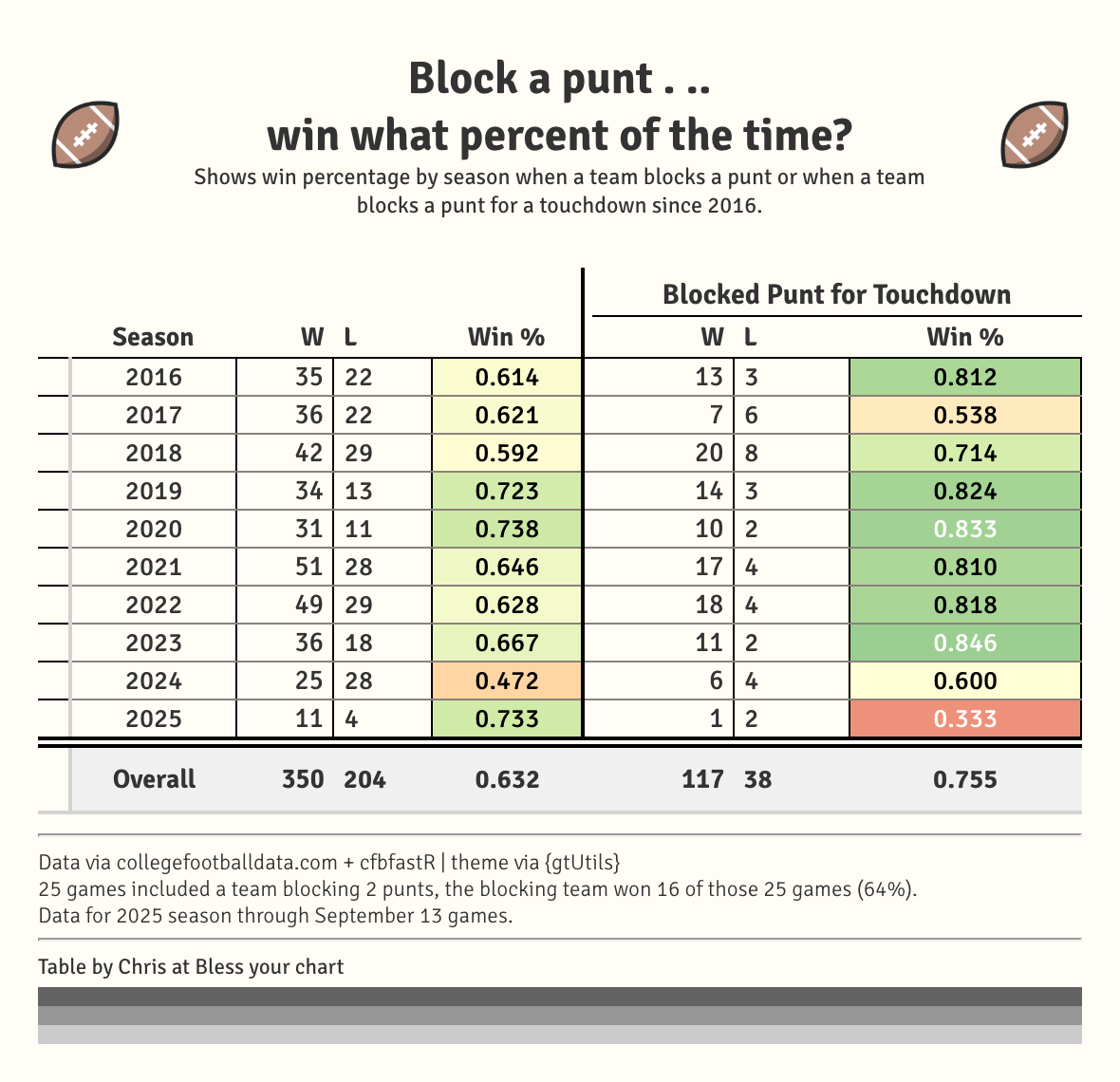
Now, a blocked punt for a touchdown is a different story.
A 155-game sample shows a team that blocks a punt for a touchdown, wins the game around 76 percent of the time.
Edge cases
Of course, there are edge cases too. While this data includes 554 games, there are actually 579 blocked punts.
There are 25 games in which a team or teams blocked more than one punt. In those games, the team that blocked two punts still only won 16 of 25 games or around 64 percent.
There are two such games, where in the same game, a total of three blocked punts are present:
NC State blocked two, including one for a touchdown and somehow one for a UNC first down, while Carolina only blocked one
South Florida 27, Tulsa 20 in 2017
South Florida blocked two and Tulsa blocked one, none for a touchdown
Overall, a blocked punt doesn’t exactly mean you win the game.
It does masquerade itself as a turnover and a way to gain an extra possession though. And a blocked punt for a touchdown serves as a turnover and an extra scoring possession.
Blocked punts matter, but winning isn't as simple as just blocking a punt.
Surface level analysis
This analysis is only exploring the surface level. A logical next step would be to figure out if the team that blocked the punt was favored entering the game or viewed as the better team.
While it might be fun to counter Urban Meyer’s claim, my guess is his teams were often the better team given he won 85 percent of his games as a college head coach.
In the sample of data from 2016 to 2018, Meyer was the head coach at the Ohio State University. The Buckeyes record when they blocked a punt?
4-0.
Ohio State did allow two blocked punts from 2016 to 2018, while they managed to lose to Penn State 24-21 in 2016 and beat Washington 28-23 in 2018 in the Rose Bowl3.
Anyhow, it’s a good reminder if you hear or read about a statistic with a 90 percent success rate to maybe exercise some healthy skepticism.
Especially, in regards to football.
Last week, the sport reminded us how weird it can be with blocked punts, botched snaps, and whatever the hell this lateral gone wrong was that turned into a 35 yard fumble return touchdown by the Purdue offense.
Recommendations
Speaking of special teams, someone much smarter than me, wrote that special teams are to football as set pieces are to soccer. That person was Parker Fleming, which brings us to this week’s recommendation.
Check out Parker’s revamped college football data site: cfb-graphs.com
It’s got a ton of interesting data and projections, including some nifty drive level data. It’s worth a visit.
And for a bonus recommendation, this article from ESPN describing what’s new in the Premier League, including details on holding during set pieces. Plus, check out this disallowed Eberechi Eze goal on a free kick.
🤟 Thanks for reading this far, and enjoy the rest of your week 🤟
Dropping a snap isn’t great, but neither is giving up 21 yards per completion on defense!
Urban Meyer once explained if a player didn’t run a 4.4 or better, he wouldn’t allow them on the punt block team.
Also, it was Meyer’s last game as head coach of Ohio State.