
190: Compound interest
Free throw rates are rising, the bonus is being reached faster, and the two-half format is compounding the problem. The NCAA knows it too.

Men's college basketball is becoming more and more efficient. According to Ken Pomeroy's data, the average Division I team generated 108.5 points per 100 possessions this season, up from 102.0 just four seasons ago.
The building blocks of efficiency help explain why. On average, teams are turning over the ball less and rebounding their own missed shots more. Combined with an uptick in effective field goal percentage, teams are attempting more shots and making them at a higher rate.
But the largest rise in any of the four factors has been the free throw rate. The average D-I free throw rate was 31.5 in the 2022-23 season and it jumped to 35.0 this past season.
Back in December, we wrote about the rise in free throw rates and tried to explain what was causing the surge. The NCAA is taking notice too.
In early May, the Division I Men's Basketball Rules Subcommittee officially discussed moving from halves to quarters during virtual meetings. No rule change was approved, but the NCAA cited "positive momentum" to make the switch. The reasons cited included pace of play, team foul resets, overall game length, fan engagement, and broadcast structure.
As John Gasaway pointed out, the last time a men's college basketball game was played in quarters was in 1954. The switch to halves came almost accidentally, through a shot clock proposal that Howard Hobson brought to that year's Final Four in Kansas City. What he got instead was two halves, as the late Dan McQuade documented in the Defector four years ago.
The NCAA first introduced a 45-second shot clock 40 years ago. It moved to 35 seconds before the 1993-94 season, and to 30 seconds before the 2015-16 campaign.
Yet, here we are still playing two halves in men’s college hoops.
So, how do free throws impact pace of play?
Let’s try to think of free throws as compound interest.
A team’s fouls, one through six, are the principal. There is no penalty unless it is a shooting foul. A hand-check or push-off does not put a team in the penalty.
As a team picks up its seventh, eighth, and ninth foul, it sends the opponent to the line for a one-and-one. This is the interest, and the second shot is only earned if the first free throw attempt is made.
Once a team picks up its 10th foul, it has reached compound interest. Every personal foul from that point forward results in two automatic free throws for the opponent. With only two halves and no reset until the half ends, a team can stay in that penalty for a good amount of game time.
Every time a team is at the free throw line, the clock stops. This elongates the game.
Game duration is something the NCAA does not surface or make easily available to the public. Any college basketball fan has experienced the purgatory of trying to switch apps to find their team's game because the previous broadcast is running over. The ESPN to ESPN+ transition is not exactly rewinding a VHS tape, but it’s an annoying part of being a fan.
Anyhow, it’s obvious that more foul shots don’t make the games any shorter.
How often are teams actually in the bonus though?
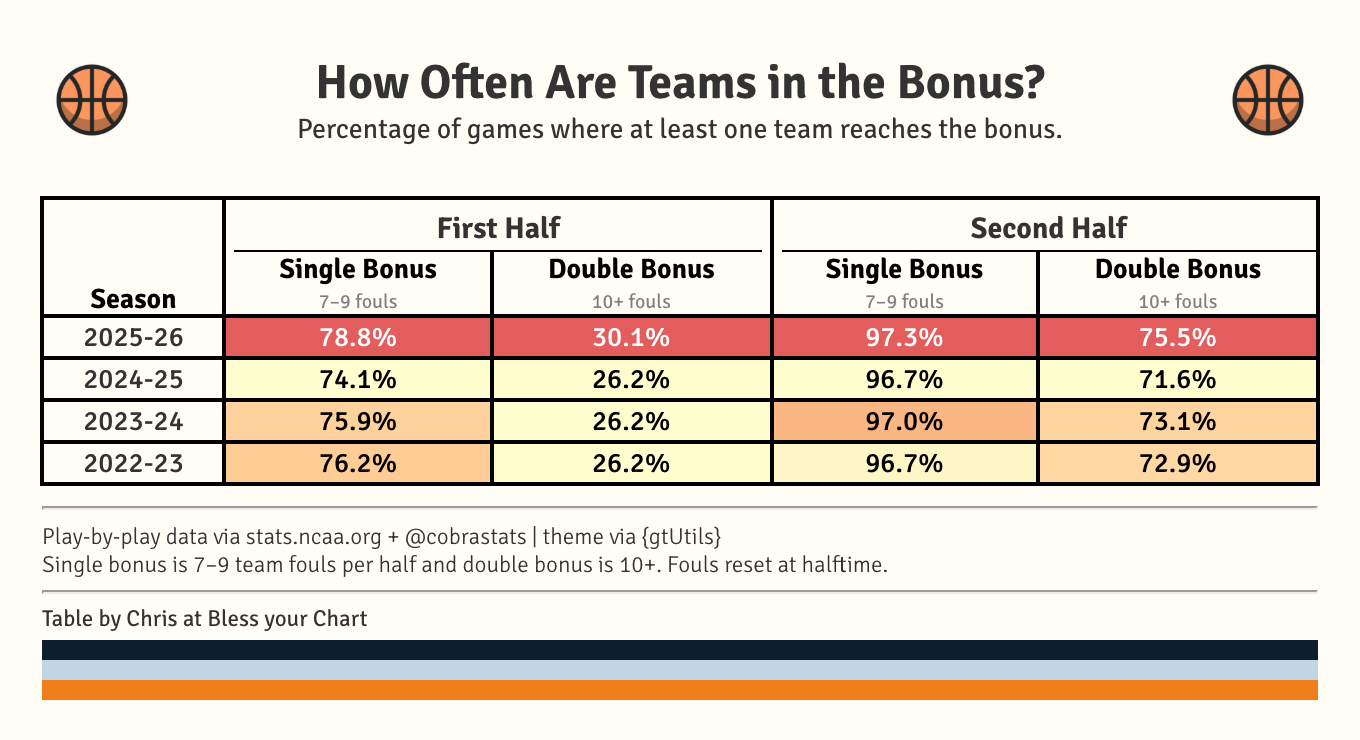
This past season, at least one team reached the bonus in 97 percent of second halves. Across 76 percent of second halves, at least one team reached the double bonus. This is up from the 2022-23 season when 73 percent of second halves featured at least one team in the double bonus.
The first half tells a different story. Only about 30 percent of first halves featured at least one team in the double bonus during the 2025-26 season. Of course, teams do foul intentionally late in the game to stop the clock, which contributes to a higher rate of the penalty in the second half and at the end of games.
An extreme example came earlier this year when Vanderbilt beat Alabama 96-90 in a game that lasted two hours and 43 minutes with 88 combined free throws. The chart below shows the total time each team spent in the bonus or double bonus.
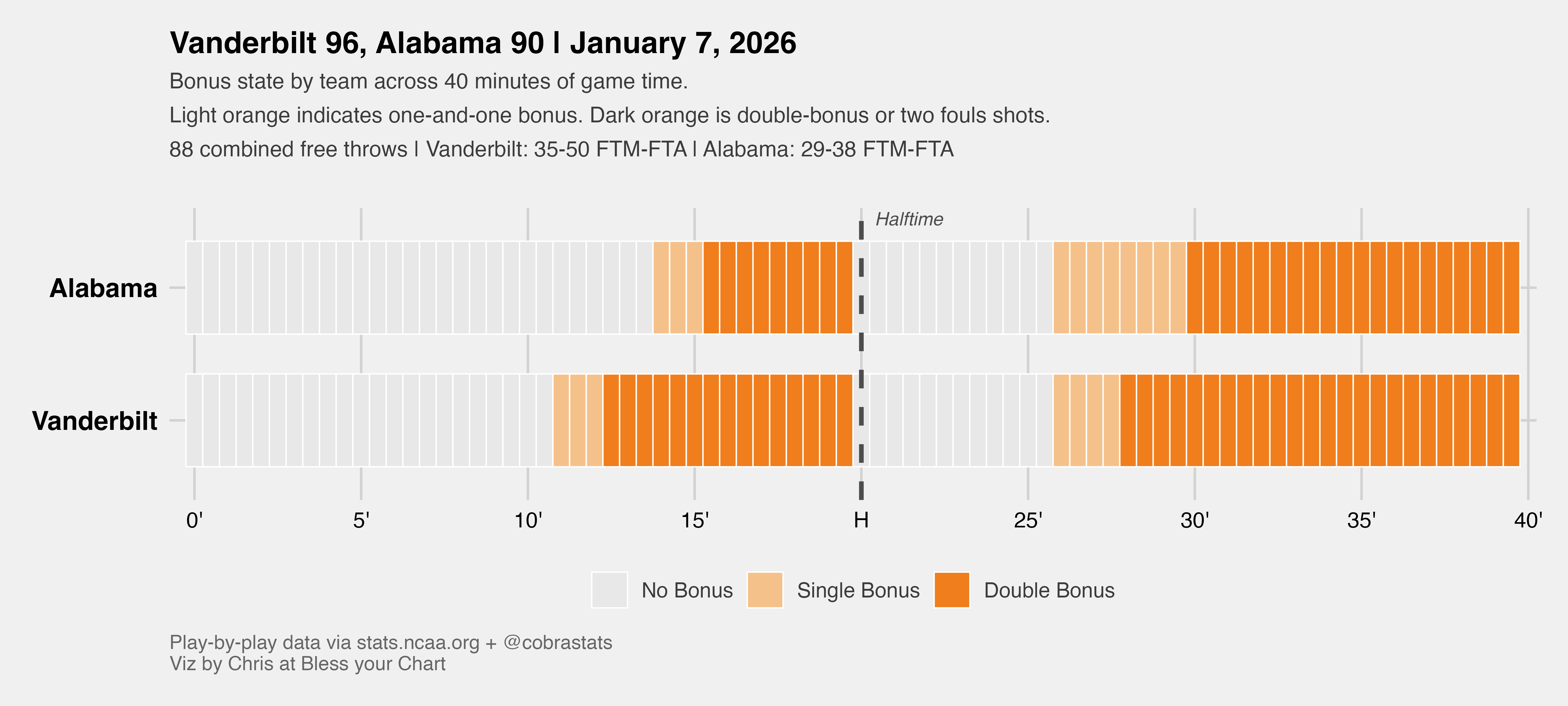
Both teams were in the double bonus for the last 10 minutes of game time. The officiating crew of Don Daily, Bart Lenox, and Brian Dorsey whistled a combined 64 fouls in the game. Vanderbilt attempted 28 shots in the second half to 33 free throws.
While this is an extreme example, it shows that the increase in free throw rates is only contributing to longer and longer games.
So, what changed this past season?
Part of the acceleration in free throw rates was a specific rule change. The NCAA implemented the continuation rule ahead of this past season. The continuation rule expanded what legally qualifies as a shooting foul. This past season saw nearly 16 shooting fouls per game on average, up from 14.9 shooting fouls per game in the 2024-25 season.
Pomeroy’s tempo numbers over the past four seasons are relatively stable at around 68 possessions per game. The game is not being played faster on average. There are more possessions that result in foul shots though.
This brings us to the one-and-one
While men’s college basketball is one of the only organized leagues that plays two halves, it does bring one unique element to the game. The one-and-one adds genuine drama and a wrinkle not found in many other forms of organized basketball.
During the second round of the 2024 NCAA Tournament, Creighton’s Ryan Kalkbrenner fouled Oregon’s N’Faly Dante with 26 seconds remaining in regulation. Oregon led 62-60. The foul meant a one-and-one situation for Oregon.
Dante missed the first free throw. Creighton rebounded. Baylor Scheierman hit a mid-range jumper with eight seconds left to knot the score at 62. Oregon missed a shot at the buzzer of regulation, and Creighton went on to win the game 86-73 in double-overtime, ending Oregon’s season.
The one-and-one is a game situation that is built into halves, and a move to quarters would likely eliminate that situation.
Is that a good thing?
Women’s college basketball eliminated it entirely when it moved to quarters before the 2015-16 season. A team moves straight to a two-shot bonus after the opponent commits its fifth foul of the quarter.
Why couldn’t the men move to quarters and make fouls five, six, or even seven award the opponent with a one-and-one chance? Any foul after that would result in two foul shots.
Instead of the one-and-one, what if the game moved to quarters and used a shorter shot clock of 24 seconds instead of 30 seconds?
If it’s not obvious that more free throws slow the game down, check the NBA’s radical rule for the 2026 Summer League. The rule states:
Any foul that would typically result in one, two or three free throws under standard NBA rules will instead result in a single free throw attempt. That attempt will be worth the same total number of points as the free throws it replaces.
Standard NBA free throw rules will apply during the last two minutes of the fourth quarter and throughout overtime.
Maybe the one-and-one is not necessary either. After all, Victor Wembanyama missed two free throws with less than two minutes to go in Game Four of the NBA Finals. The Knicks went on to complete a miraculous comeback and later defeat the Spurs in Game Five to win the NBA title.
Quarters would change the game flow
Quarters wouldn’t necessarily fix the trend in more shooting fouls. The continuation rule is doing that today, and overall, that feels like a welcome change to the game.
What quarters would change is the compounding interest that slows the pace of play. If the foul counts reset every ten minutes instead of every twenty, the game should move a bit faster.
Yes, you need to figure out the media timeouts and the one-and-one rule. The NCAA already did that with the women’s game, so there is a proof of concept. Even FIFA introduced “quarters” in the form of hydration breaks in the 2026 World Cup. The clock doesn’t stop, but the structured breaks are paying off.
Let’s remember that television runs the sport.
Those executives want games that finish on time and run on schedule. When broadcasts are consistent, they are easier to manage and easier to sell. That’s why it feels like the move towards quarters will happen sooner rather than later.
It’s time to reset the ledger more often and reduce the compound interest.
That’s it for this week, thanks for reading this far.
A big thank you to Connor (cobrastats) for his help in fetching the play-by-play over the past several seasons.
🤟 Enjoy the summer and the World Cup (what is offsides anyway?) 🤟