
176: Spring Forward: Time, Tempo, and Deliberate Duke
Digging into average possession length in college basketball and Duke's deliberate efficiency.

This weekend most of Canada and the United States will set the clocks an hour forward for Daylight Saving time.
It will mark the last time that the Province of British Columbia practices Daylight Saving time. The Province is choosing to eliminate twice-yearly time changes to reduce disruptions, simplify scheduling, and provide an extra hour of light during the winter months.
As we all spring forward, so is the college basketball season. Time is starting to compress and most college basketball teams wish they could control time like the Province of British Columbia.
Selection Sunday is suddenly 10 days away.
On the court, time is a funny thing to track. NCAA Men’s college basketball is one of the only organizations that plays two 20-minute halves. The 40-minute game has built in timeouts for television every four minutes or so.
Teams are tied to a 30-second shot clock. The shot clock resets to 20 seconds when a team snags an offensive rebound to extend a possession.
There are 365 Division-I teams and there is more than one way to be successful. And how teams use time with the ball varies dramatically.
Take the top-10 teams rated in Ken Pomeroy’s power ratings through March 4 games. Pomeroy surfaces a tons of stats that reveal a team’s style. This includes the average possession length in seconds for teams on offense and defense.
Here is how those top-10 teams differ across average possession length on both offense and defense:
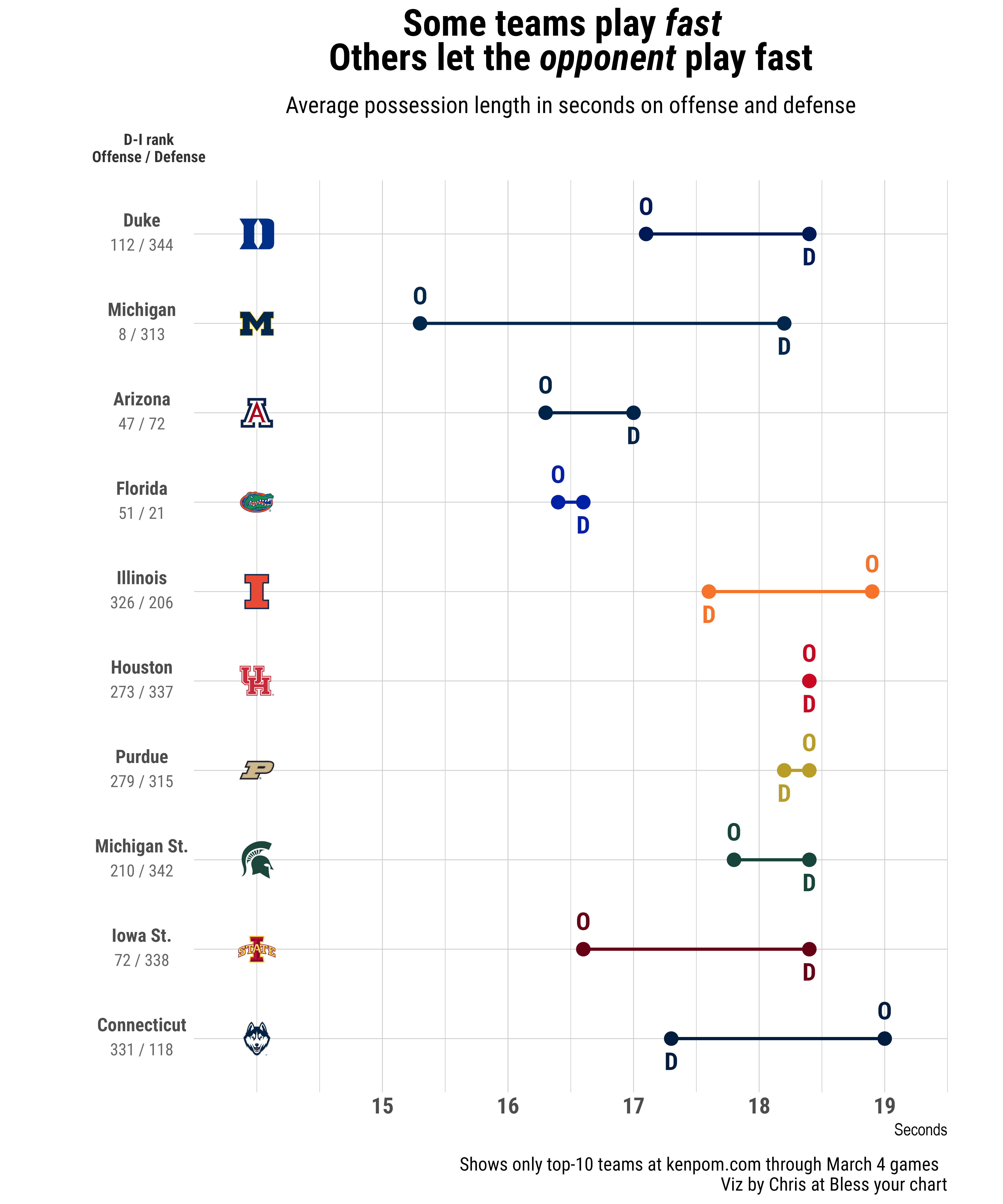
Over half of the teams have a longer average possession length on defense than offense. Slow defensive possessions tend to mean better defense, and the data backs that up. Duke, Michigan, Arizona, Florida, and Michigan State all play defense longer than offense, and all five own the best defensive rating, in order, in Pomeroy’s numbers.
Houston’s average possession length on offense and defense is an identical 18.4 seconds. You have to appreciate Kelvin Sampson’s point of view in his style of play regardless of player personnel. It’s always a grind.
Florida is a good antidote to the Cougars’ style of play. The defending champions attack with short offensive possessions and the fastest defensive possessions amongst these top-10 teams.
Arizona plays fast on offense and doesn’t mind opponents playing fast either. While Connecticut plays the “slowest” among all 10 teams on offense with an average possession length at 19 seconds, though Illinois is a hair behind at 18.9 seconds.
What’s fascinating is if you watched UConn and Illinois execute on offense, I’m not sure you would describe those offenses as slow. Sure the possession takes time, but there are elaborate sets with lots of cuts and movement to get good shots.
This is when just staring at the numbers can be a bit misleading. Pomeroy has attributed tempo to mostly average possession length on offense, but don’t confuse tempo with speed. Tempo is more about rhythm and control where speed is more about covering distance over time.
Now pace measures time over distance or in basketball pace measures how many chances (possessions) a team typically plays in a given game.
I’ve always loved this quote from hall of fame coach Roy Williams on playing fast:
My offensive philosophy is that we’re going to run. We’re going to try to make the other team’s players run faster and longer than they ever have run in their lives . . . because if I’m better than you are, the more possessions we play, the more likely it is that I’m going to beat you. If I play golf against Tiger Woods for one hole I might beat him, but over 18 holes, I have no chance.
Roy Williams with Tim Crothers, Hard Work: A Life on and off the Court
This has become a fundamental belief of mine when watching college basketball or maybe it’s just my preference in a style of play.
This brings us to Duke, the top-rated team in Pomeroy’s ratings.
Does Duke prefer to play slow or deliberate?
Duke’s adjusted efficiency margin is soaring in Pomeroy’s ratings. We’ve somehow convinced ourselves that Duke doesn’t get enough credit, Duke is maybe the best team ever, and Duke is underrated.
All at the same time.
As someone who prefers a lighter shade of blue, Duke’s style of play under Scheyer is just as annoying as the Blue Devils’ dominance over the past two seasons.
I’ve quietly used the phrase “slow-it-down-Scheyer” when describing how Duke prefers to play. But I’m not sure slow is the right word.
Duke ranks 112th out of 365 teams in average offensive possession length at 17.1 seconds. Kentucky ranks 58th and plays about half a second faster on average on offense.
If we believe that the offense is in more control of its average possession length, and that is more of a driver of tempo, then I’m not sure the style of play is slow.
Now, I believe Duke’s tempo is more deliberate. And the Blue Devils have become more deliberate and more efficient over the season.
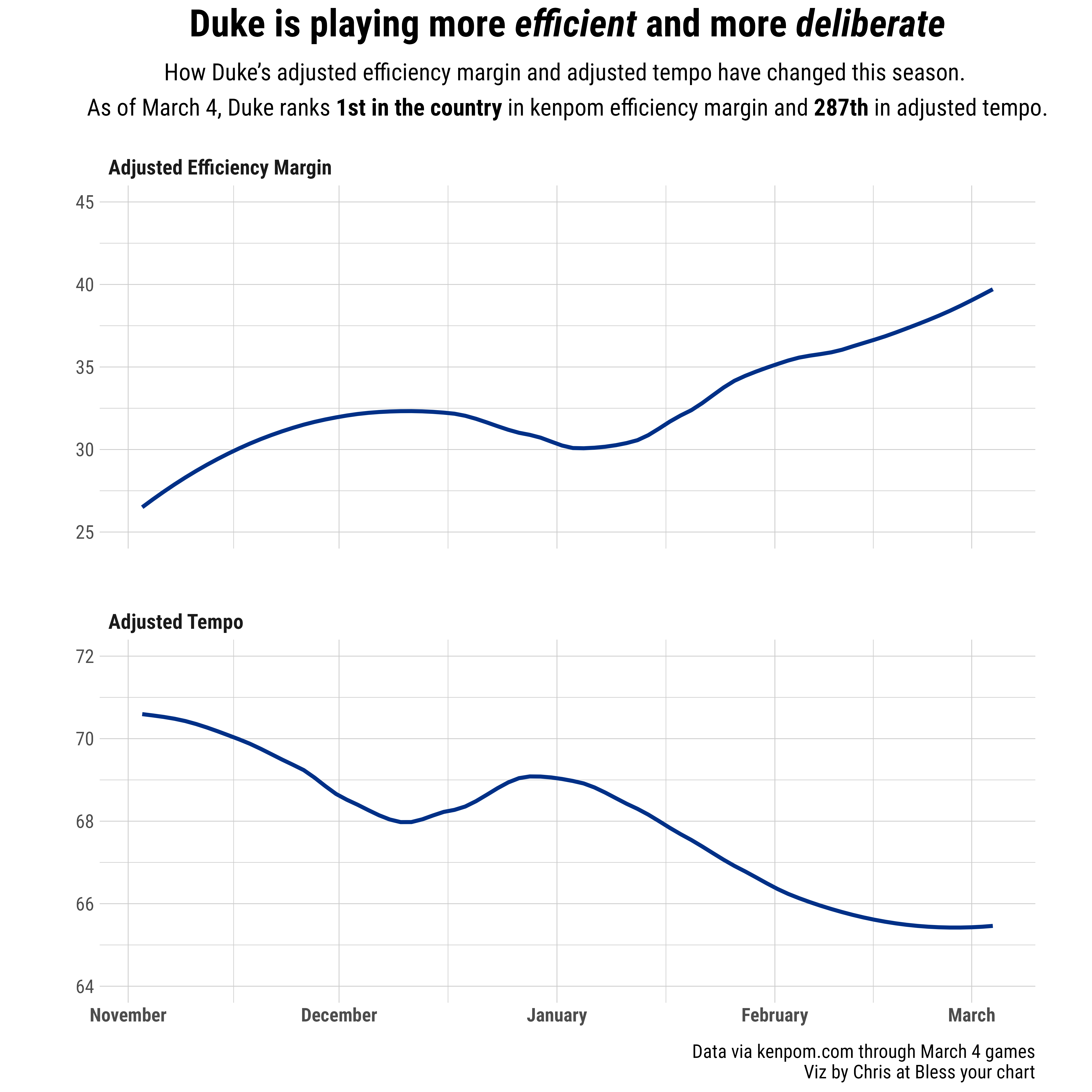
Since mid-January, Duke has played one game over 65 possessions with a 13-1 record over this stretch. The one game above 65 possessions was a 44-point win on the road at Notre Dame, played at 72 possessions.
The lone loss over the past 14 games was to rival North Carolina. As a reference, Carolina is not as lightning fast under now head coach Hubert Davis as the Heels were under Roy Williams. But Davis is a disciple of Williams, and he is on record that he wants to be the fastest team from free throw line to free throw line in the country.
Carolina’s average possession length on offense is 16.8 seconds or 86th out of 365 D-I teams. On defense, Carolina ranks 293rd in average defensive possession length at an average of 18 seconds.
So, how the hell did Carolina beat Duke?
When you first watched or re-watched the game, it felt as though you were waiting for the Blue Devils to knock out UNC. It just never happened.
Duke’s defense is the best in the country. You saw this early in the game as Duke led 14-5 after about five minutes of play.
Carolina was kept afloat in the first half because freshman Caleb Wilson managed to score over-and-over again.
UNC did try to run or get out in transition against Duke. The Tar Heels simply were not successful and botched several transition opportunities scoring just two fast break points in the first half. Duke stretched its lead to 11 points by halftime.
The second stanza was a different story. Now, Carolina was whistled for one total foul in the second half. That’s a fact, and it’s a point many fans believe is the reason why Carolina won the game.
Remember that we must believe in luck because how else can we explain the success of those we don’t like.
What’s also a fact is the Blue Devils scored nine total points over the final 10 minutes of game time. Duke missed 13 of its last 17 shots.
Let’s plot the possessions.
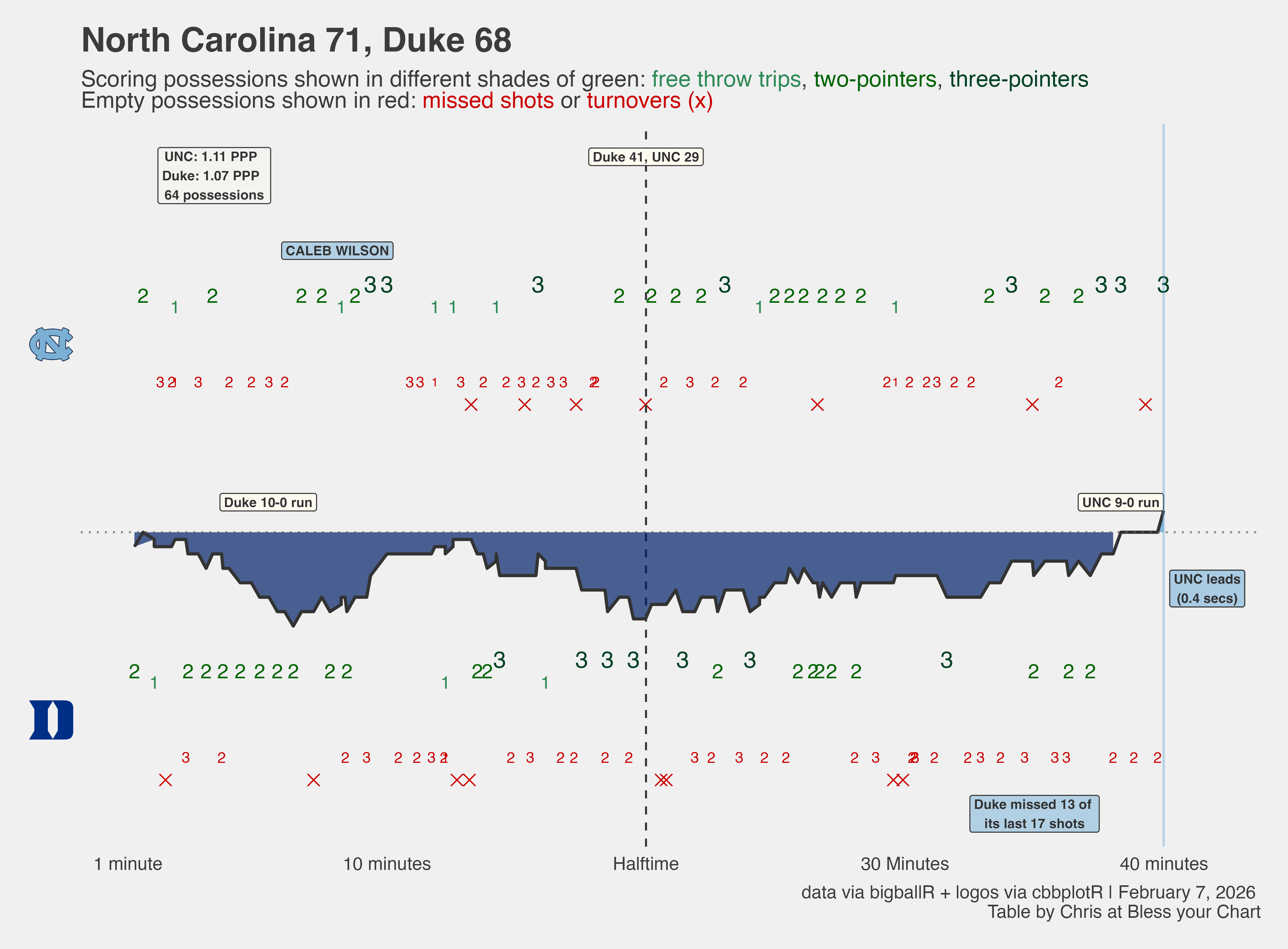
Carolina hung around despite going through a scoring drought in the middle of the second half because Duke matched that scoring drought. Carolina put together a 9-0 run to close the game with a score-stop-score-stop-turnover-stop-score sequence.
Duke’s average possession length on offense on those last three empty possessions was around 23 seconds. This included back-to-back missed two-point shots by Cam Boozer in possessions well over 20 seconds.
Now, that’s not why Duke lost, but it’s also part of why Duke didn’t win or extend the lead. Boozer is the expected National Player of the Year for good reason, he is a methodical player with uncanny composure. The Blue Devils expected Boozer to execute down the stretch.
But it didn’t work out.
Carolina’s offensive possessions were productive, though not terribly short. Henri Veesaar drained a three-point shot about 15 seconds into the shot clock to the tie the game, which was the most aggressive and shortest possession down the stretch.
UNC found the bottom of the net three times all behind the three-point line to close the game on a 9-0 run to gain its first lead with 0.4 seconds before the buzzer ended.
Roy Williams believed more possessions meant more chances for the better team to win. Jon Scheyer seems to believe the opposite, that fewer, more deliberate possessions is better.
The beauty is that both strategies can bring success.
Like the Province of British Columbia, as a head basketball coach, you can choose how you want to try to control time.
That’s it, and thanks for reading this far.
No bracketology this week, I’m leaving that to the professionals 🙃
You can check out wabwatch.com though if you want to take a look at Miami Ohio’s perfect 30-0 record using WAB.
Carolina and Duke meet for the second time this season on Saturday. It’s logical to expect a different game and outcome. UNC is shaky on the road, Duke is stellar at home, and Pomeroy even suggests Duke will win by 16 points.
It will mark the 13th time that Carolina is a double-digit underdog at Duke, according to TeamRankings BetIQ tool. Carolina is 3-9 straight up in the previous 12 meetings.
It’s the game that always delivers, and the fun is we don’t for certain what it will deliver on Saturday.
Sticking with the Duke theme, a recommendation this week is an interview with Shane Battier on the Bet the Process podcast. Battier talks NBA analytics and coaching his own children, with some culture and corporate speak sprinkled in. Overall, a good interview on the game of basketball and how it’s changed.
🤟 Don’t forget to set those clocks forward this weekend 🤟
Excellent work as always.